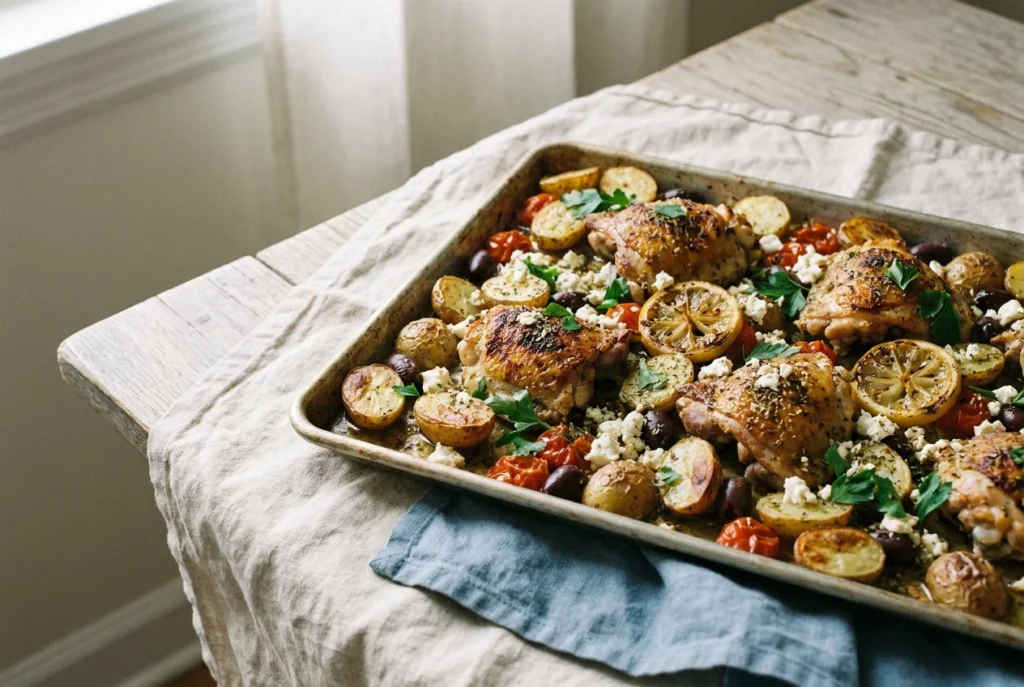
This sheet pan Greek chicken is the weeknight version of a Sunday roast: thighs and baby potatoes on one tray, seasoned hard with oregano and lemon, then left alone in a hot oven until the skin goes crackling and the potatoes catch at the edges. Feta and olives go on at the very end, off the heat, so the cheese stays crumbly instead of melting into the pan.
It belongs squarely to the Mediterranean way of eating — olive oil as the main fat, vegetables by volume, meat roasted whole rather than processed — the pattern described by the Harvard T.H. Chan School of Public Health. Browse the full recipe archive for more in the same register.
Why this sheet pan Greek chicken works
- The potatoes go in first. Twenty minutes of head start means they finish golden at the same moment the chicken skin does, instead of coming out chalky in the middle.
- Dried oregano beats fresh here. It is one of the few herbs that improves with heat — fresh oregano scorches to bitterness at roasting temperature.
- Nothing is crowded. A single layer with space between pieces lets moisture escape, which is the entire difference between roasted and steamed.
- 47g of protein per serving from a cut that stays juicy even if you overshoot the timer by five minutes. Chicken breast does not forgive that.
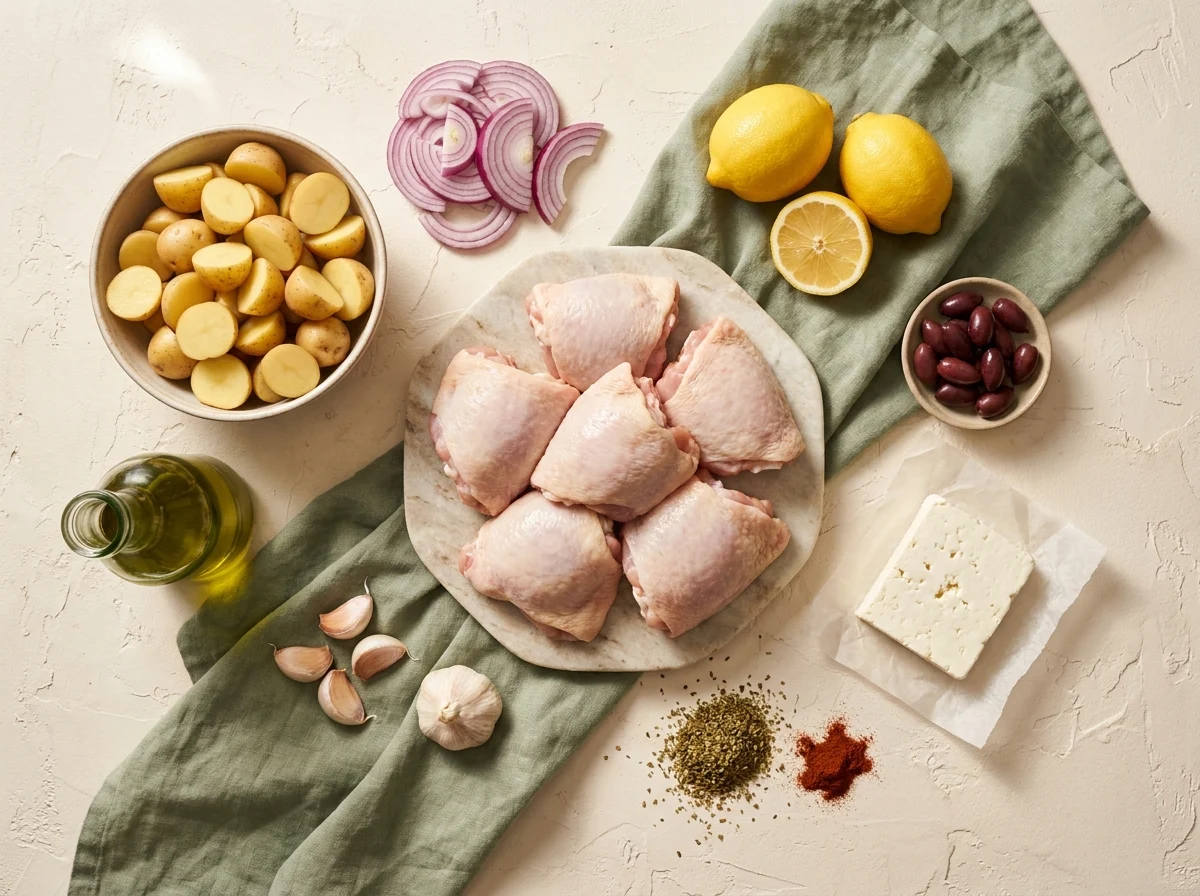
Ingredients
Makes 4 servings.
Equipment
How to make it
- Heat the oven properly. 425°F (220°C), rack in the upper third. Let it come fully to temperature — 15 minutes past the beep. An under-heated oven steams instead of roasting.
- Dress the potatoes. Toss the halved potatoes and onion wedges with 2 tbsp of the olive oil, 1 tbsp oregano, ½ tsp salt, and pepper. Spread cut-side down in a single layer and roast 20 minutes.
- Marinate the chicken while they roast. Combine the remaining 2 tbsp oil, 1 tbsp oregano, grated garlic, smoked paprika, the juice of one lemon, 1 tsp salt, and plenty of pepper. Turn the thighs through it until fully coated. Fifteen minutes on the counter is enough.
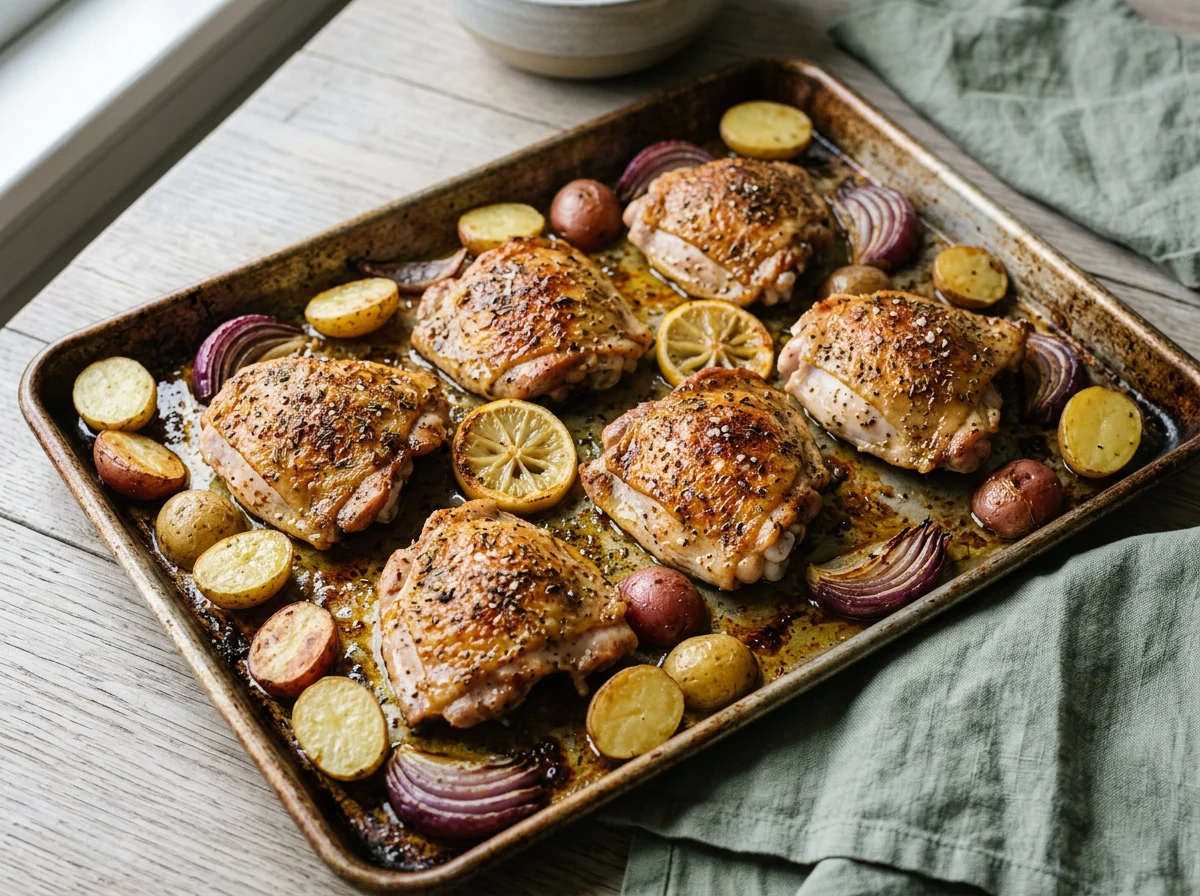
- Add the chicken and roast on. Pull the pan out, push the potatoes to the edges, and lay the thighs in the middle with the lemon rounds tucked between. Roast 20 minutes.
- Finish with the tomatoes. Scatter the cherry tomatoes over and roast a final 8 to 10 minutes, until they split and the chicken reads 165°F (74°C) at the thickest point. This is a food-safety threshold, not a preference — check it with the thermometer rather than by colour.
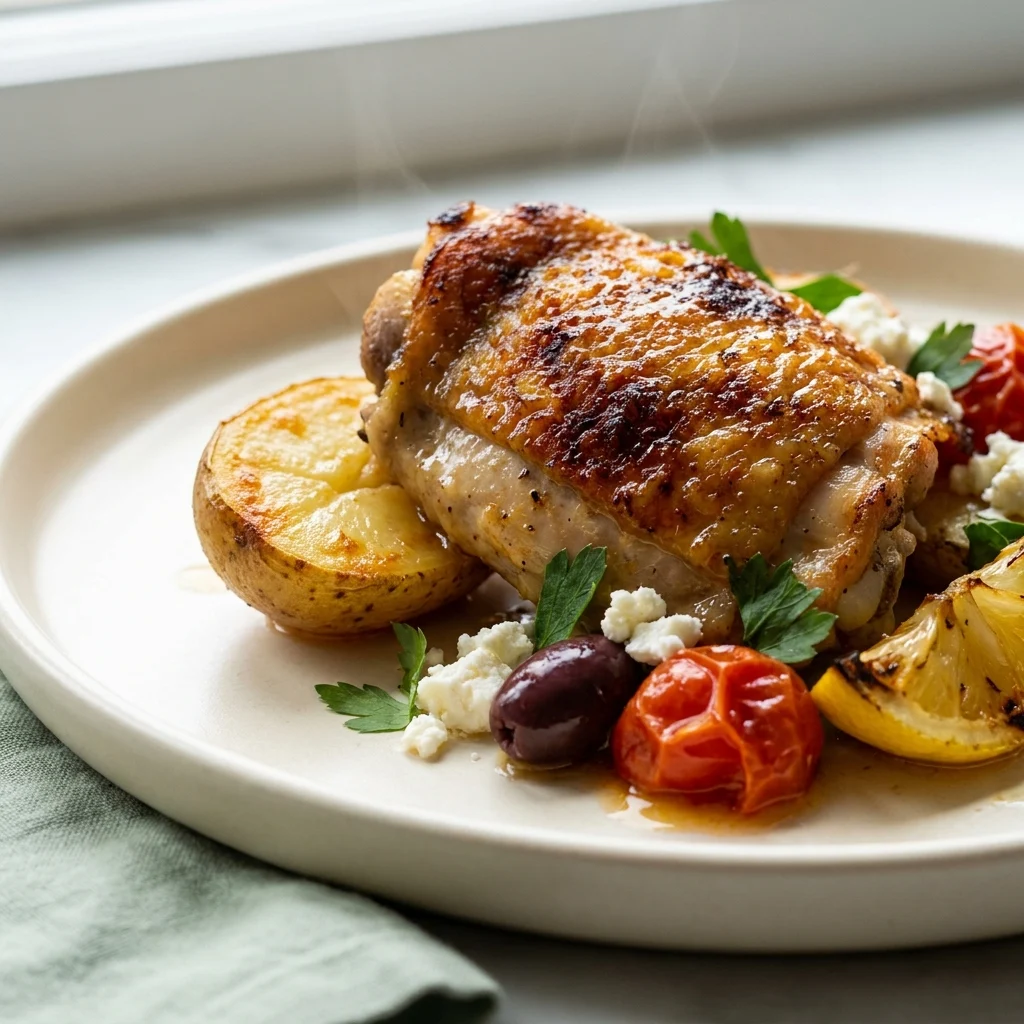
- Off the heat, then dress. Rest 5 minutes, then scatter the olives, crumbled feta, and parsley over the hot tray. The residual heat softens the feta without melting it. Serve straight from the pan.
Tips from the test kitchen
- The most common failure is a crowded pan. If everything will not fit in one uncrowded layer, use two pans. Piling it higher turns the whole tray grey and wet.
- Halve the potatoes, do not quarter them. Smaller pieces finish before the chicken and dry out waiting.
- Add the feta off the heat, always. Roasted feta turns rubbery and weeps. Sixty seconds of residual pan heat is exactly enough.
- Save the pan juices. The lemon, oil, and rendered fat at the bottom is the sauce. Spoon it back over everything before serving.
- Bone-in, skin-on works too. Add 10 minutes and start the thighs skin-side up from the beginning.
Swaps and variations
- Chicken breast — cut the final roast to 12 minutes total and pull at 160°F (71°C), carryover does the rest. Drops about 8g fat and 60 kcal per serving.
- Swap potatoes for cauliflower — roast from the start with the chicken rather than ahead. Cuts roughly 25g carbs per serving.
- Add a red bell pepper, cut into wide strips, with the chicken. Adds about 10 kcal and 2g carbs per serving.
- Leave out the feta to make it dairy-free. Removes about 56 kcal, 3g protein, and 4.5g fat per serving.
Storage and meal prep
Cooked as a mediterranean sheet pan dinner, the greek chicken and potatoes keep better apart than together: the potatoes stay crisp in an open container while the greek chicken thighs hold their juice in a sealed one.
Leftover sheet pan Greek chicken keeps in the fridge for 4 days in a sealed container. Reheat in a 400°F (200°C) oven for 10 minutes rather than the microwave, which turns the potato skins leathery and the chicken stringy. It freezes for up to 3 months, but freeze the chicken and potatoes only — feta goes grainy and the olives turn bitter, so add both fresh after reheating. For meal prep, roast the tray on Sunday and portion it cold; it is one of the few roasts that eats well straight from the fridge with a squeeze of lemon.
Nutrition per serving
| Nutrient | Per serving |
|---|---|
| Calories | 610 kcal |
| Protein | 47 g |
| Fat | 28 g |
| Total carbs | 42 g |
| Fiber | 7 g |
| Net carbs | 35 g |
Nutrition is an estimate and varies with brands and exact portion sizes.
Frequently asked questions
Can I cook this one pan greek chicken with breasts instead?
You can, but drop the oven time by about eight minutes and pull them at 74C. Breasts give you the same lemon oregano chicken flavour with far less margin for error, which is why thighs are the default here.
Can I make sheet pan Greek chicken ahead of time?
Yes, up to a point. Marinate the chicken up to 24 hours ahead and halve the potatoes the night before, stored covered in cold water. Roast on the day — a fully cooked tray reheated is good, but the skin and potato edges are never quite as crisp the second time.
Why did my potatoes come out soft instead of crisp?
Three usual causes: the pan was crowded, the oven was not fully preheated, or the potatoes were not cut-side down. All three trap steam against the surface that should be browning. A dark metal pan also browns considerably better than a light or glass one.
Is this recipe actually Mediterranean-diet friendly?
Yes. Extra-virgin olive oil is the only added fat, vegetables outweigh the meat by weight, and poultry is exactly the kind of protein the pattern favours over red or processed meat. The feta is a modest amount of the fermented dairy the pattern also allows.
Do I have to use an instant-read thermometer?
For chicken, yes. Colour and clear juices are unreliable indicators, and thigh meat stays slightly pink even when fully cooked. 165°F (74°C) at the thickest point is the standard food-safety threshold and takes two seconds to confirm.
Can I double it for a crowd?
Yes, but use two separate pans on two racks rather than one overloaded tray, and rotate them top to bottom halfway through. Doubling onto a single pan is the fastest way to lose every bit of browning.
Ratings and reviews
No ratings yet. If you have cooked this, your rating helps the next person decide.
Rate this recipe