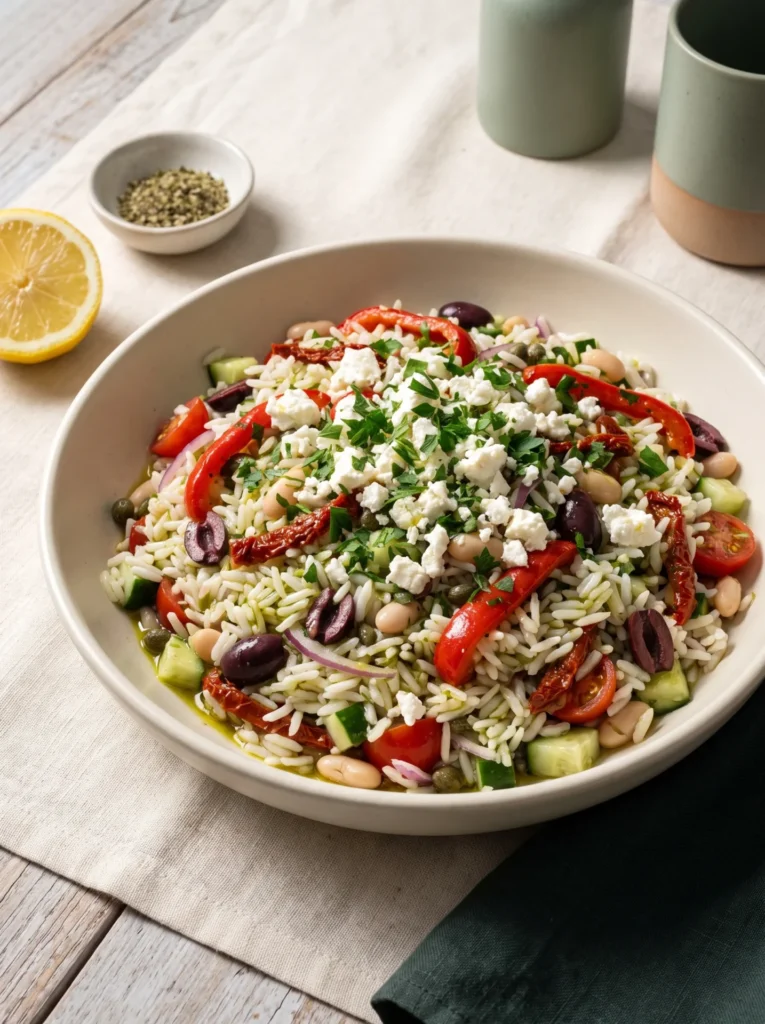
A make ahead Mediterranean rice salad is the rare dish that is genuinely better on day two: the grains keep drinking the lemon and oregano dressing overnight, and the olives, capers and sun-dried tomatoes go on seasoning everything around them. There is no oven and no reheating — the only heat is the pot of rice, and that is also the trick, because warm grains absorb dressing that cold ones simply shed. It belongs to the Mediterranean way of eating: olive oil, beans, vegetables, herbs by the handful, and cheese used as seasoning rather than as bulk.
Table of Contents
Why this make ahead Mediterranean rice salad works
- Warm rice is a sponge. Dressing poured onto grains that are still steaming is pulled into the starch instead of pooling at the bottom of the bowl, which is why the flavour reaches the middle of every grain rather than sitting on the surface.
- The pantry does most of the seasoning. Olives, capers, sun-dried tomatoes and jarred roasted peppers are already salted and acidic, so the dressing itself needs very little beyond lemon, oil and oregano.
- Feta and herbs go in last. Fold them in early and the feta dissolves into a chalky slick while the parsley blackens; held back until serving, both stay distinct.
- Nothing needs reheating. It is eaten cold or at room temperature, so there is no step between the fridge and the plate.
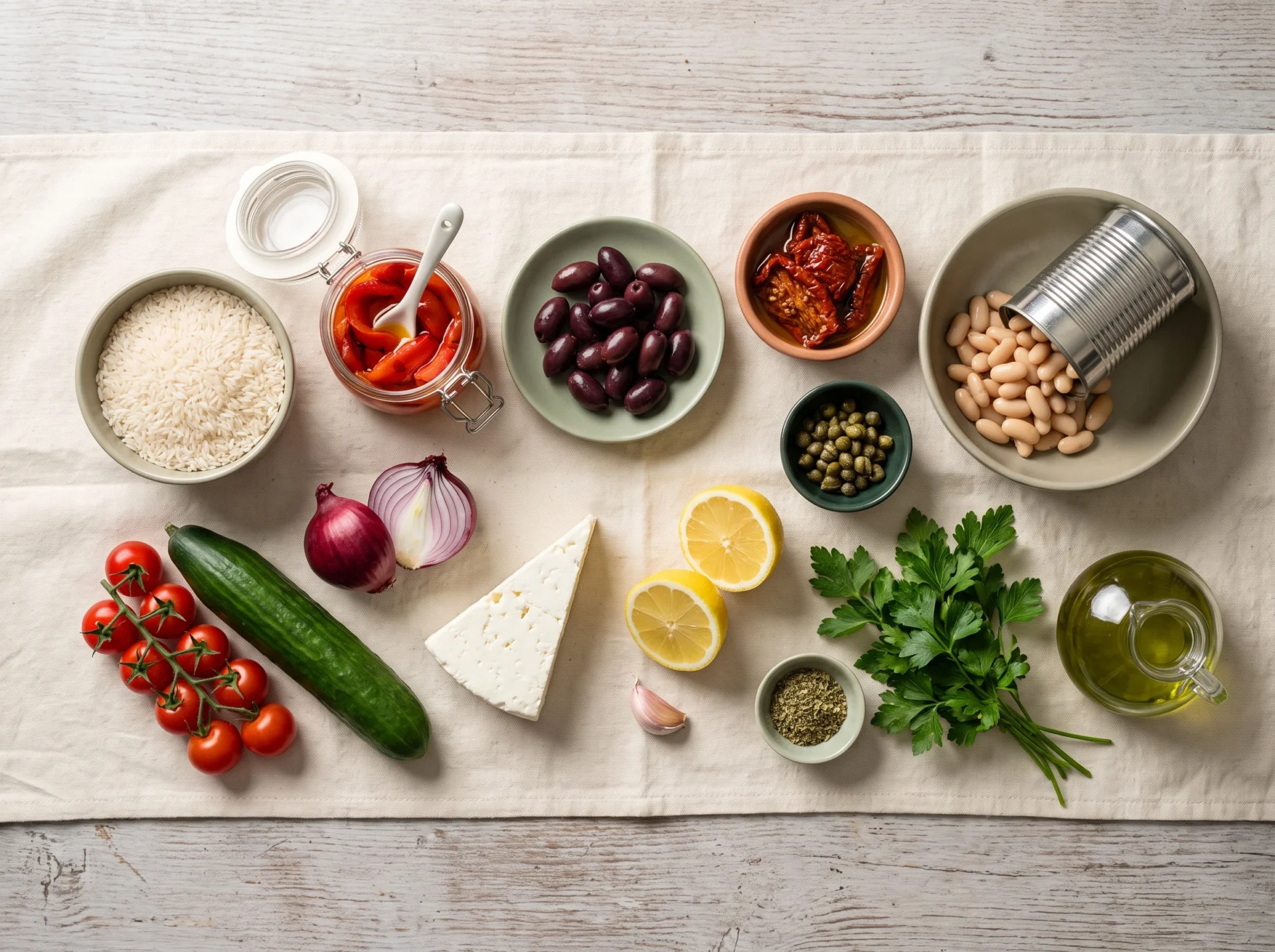
Ingredients
Makes 6 servings.
Equipment
How to make it
- Cook the rice. Bring the rinsed rice, water and 1/2 teaspoon of the salt to a boil, cover, drop to the lowest heat and cook 15 minutes. Off the heat, leave it covered another 10 minutes, then fork the grains loose — they should separate cleanly rather than clump.
- Shake the dressing. Put the olive oil, lemon juice, oregano, grated garlic, the remaining 1/2 teaspoon salt and the black pepper in a jar and shake hard until it looks cloudy and slightly thickened.
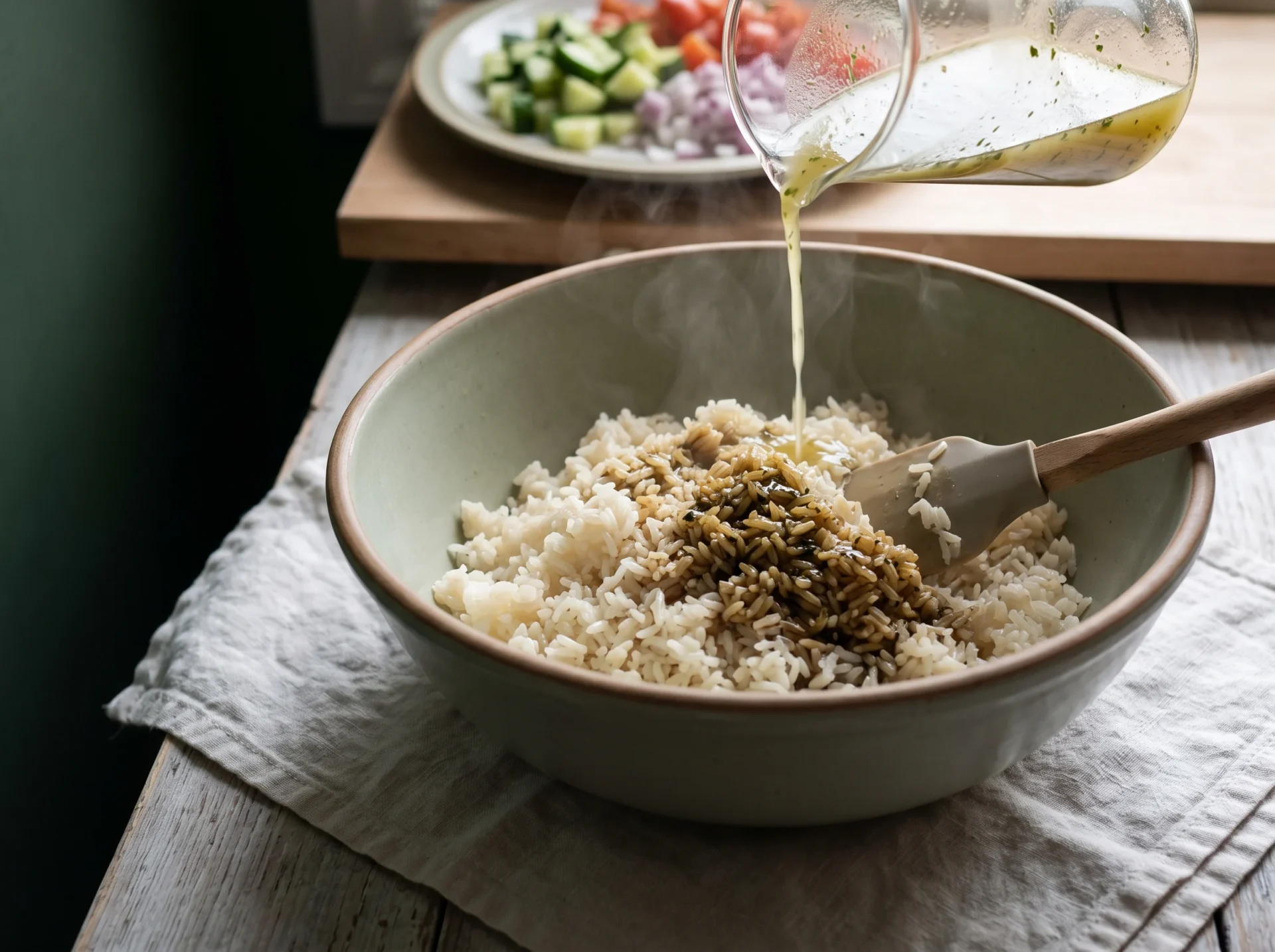
- Dress the rice while it is warm. Tip the rice into the wide bowl, pour over about two thirds of the dressing and fold gently with a spatula. It should glisten, not swim. This is the step that decides the whole dish.
- Dry the briny things. Pat the roasted peppers, olives, capers and sun-dried tomatoes on paper towel until no liquid clings, and toss the diced cucumber with a pinch of salt in a sieve for 10 minutes, then pat it dry too. Wet add-ins are what turn the salad watery by morning.
- Fold everything in. Add the beans, peppers, olives, sun-dried tomatoes, capers, red onion, cucumber and cherry tomatoes to the cooled rice and fold rather than stir, so the beans stay whole.
- Chill it. Cover and refrigerate at least 2 hours and up to overnight. Get it into the fridge within two hours of the rice coming off the heat.
- Finish at the table. Within half an hour of serving, fold through the parsley, scatter the feta over the top and add the last of the dressing if the rice has drunk it all. Taste for salt only now, once the olives and feta are in.
Practical cooking tips
- Hold back a third of the dressing. A cold rice salad tastes flatter straight from the fridge than it did warm; the reserved dressing is what brings it back rather than extra salt.
- Soak the onion if it is fierce. Two minutes in cold water takes the raw bite off without losing the crunch, which matters in a dish that will sit for a day.
- Use a wide bowl, not a deep one. Rice cools and dresses evenly when it is spread out; in a deep bowl the bottom stays hot and compacts.
- The common failure is water, not seasoning. Undrained peppers, unsalted cucumber and wet olives together release enough liquid overnight to leave a puddle under the rice.
Swaps and variations
- Brown rice. Same 280 g dry weight, cooked in 3 1/2 cups water for 40 minutes. It adds about 1 g of fiber and 1 g of fat per serving and leaves the calories effectively unchanged.
- Chickpeas for cannellini. A straight swap by drained weight adds about 4 kcal and 1 g of fiber per serving, and gives a firmer bean that holds its shape better over three days.
- Add tuna. Two 5 oz (142 g) cans of tuna in olive oil, drained, add roughly 65 kcal and 11 g of protein per serving and turn it from a side into a main.
- Dairy-free. Leave out the feta and the dish becomes vegan; that removes about 62 kcal, 3 g protein and 5 g fat per serving, so add a tablespoon of extra olive oil and a squeeze more lemon to compensate for the loss of salt and richness. For a rice salad with feta done as a warm bowl instead, see the no-cook Mediterranean shrimp salad for the same brine-and-lemon idea with seafood.
Storage and meal prep
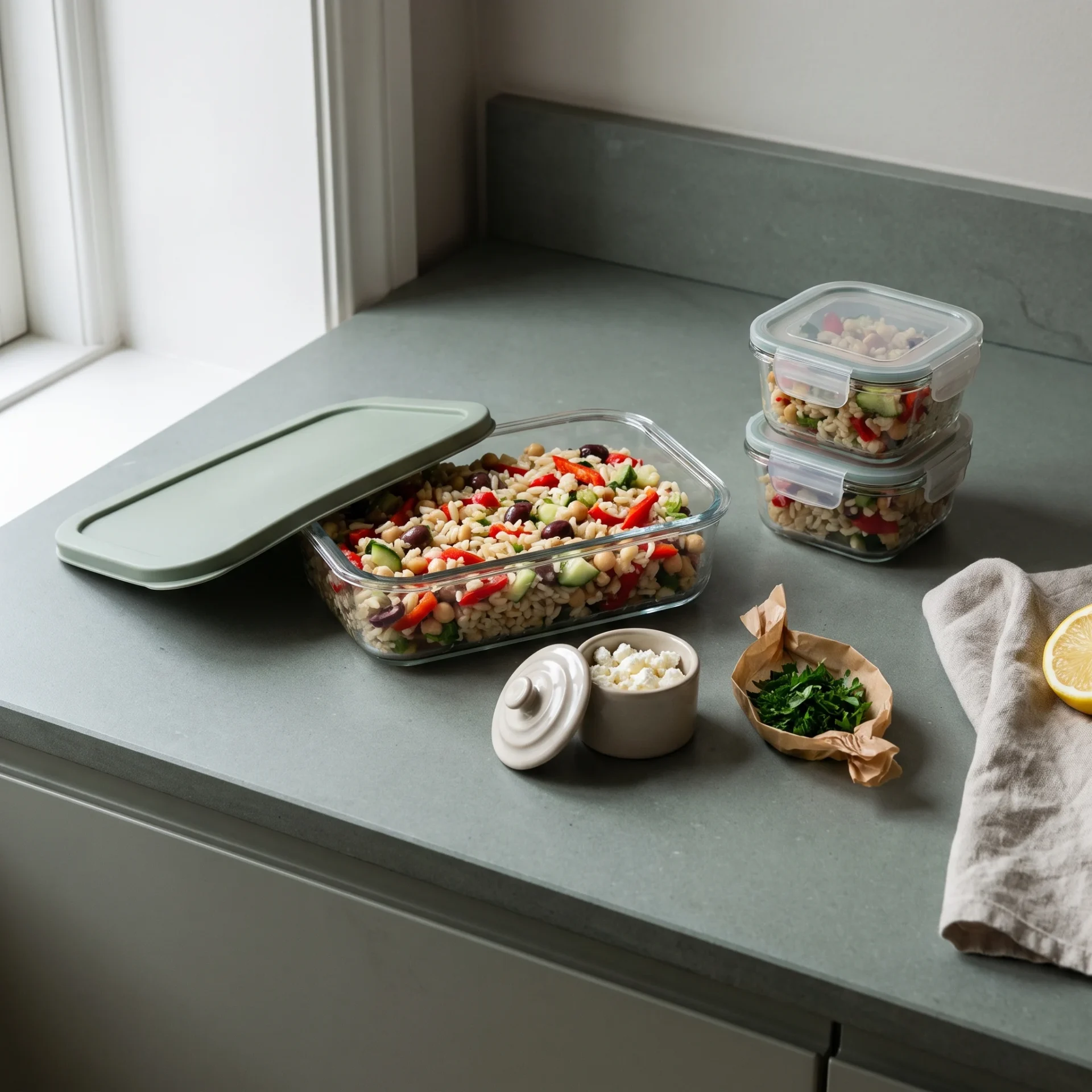
Undressed with feta and parsley, the make ahead Mediterranean rice salad keeps three to four days in the fridge, which matches the USDA three-to-four-day window for cooked leftovers; the same guidance asks that cooked food goes into the fridge within two hours, and that matters more here than in a hot dish, because nothing will be reheated to correct a slow cool-down. Cooked rice held at room temperature is the classic setting for Bacillus cereus, so the pot goes from stove to bowl to fridge without a long wait on the counter. This is what makes it a genuine make ahead salad for a crowd: build the whole batch the night before, keep the feta and parsley in their own small pots, and finish it in two minutes when people arrive. Do not freeze it — the rice turns chalky and the cucumber collapses on thawing. If it looks tight on day three, loosen it with a tablespoon of olive oil and a squeeze of lemon rather than more dressing.
Nutrition per serving
| Nutrient | Per serving |
|---|---|
| Calories | 478 kcal |
| Protein | 13 g |
| Fat | 21 g |
| Total carbs | 61 g |
| Fiber | 7 g |
| Net carbs | 54 g |
Calculated from the quantities above using composition data from USDA FoodData Central. Nutrition is an estimate and varies with brands and exact portion sizes.
Frequently asked questions
How far ahead can I make this make ahead Mediterranean rice salad?
Up to a full day ahead for the best version, and three days if you are treating it as lunches. Two hours in the fridge is the minimum for the dressing to travel through the rice; beyond about 24 hours the cucumber starts softening even when it has been salted and dried.
Is this the same as a Greek rice salad?
Close, but not identical. A Greek rice salad usually stops at cucumber, tomato, olives, onion and feta; this one adds capers, sun-dried tomatoes and white beans, which is what lets it stand up to a night in the fridge instead of wilting.
Should it be served cold or at room temperature?
Room temperature tastes better. Take it out about twenty minutes before serving; olive oil firms up in the fridge and mutes everything, and it loosens again as the salad warms.
Why did mine go watery overnight?
Almost always the cucumber and the jarred peppers. Salting the cucumber for ten minutes and patting every drained ingredient dry removes most of the liquid before it can collect under the rice.
Can I use leftover rice instead of cooking a fresh pot?
You can, but it will not absorb the dressing the same way, and it must be rice that was cooled quickly and refrigerated within two hours of cooking. Warm the cold rice briefly before dressing it, and count the salad’s fridge life from the day the rice was originally cooked, not the day you assemble it.
What goes with it?
Anything grilled and simple — chicken, lamb, or fish straight off a hot pan — since the salad already carries the acid and the salt. There are more pairings across the recipe archive.
Ratings and reviews
No ratings yet. If you have cooked this, your rating helps the next person decide.
Rate this recipe