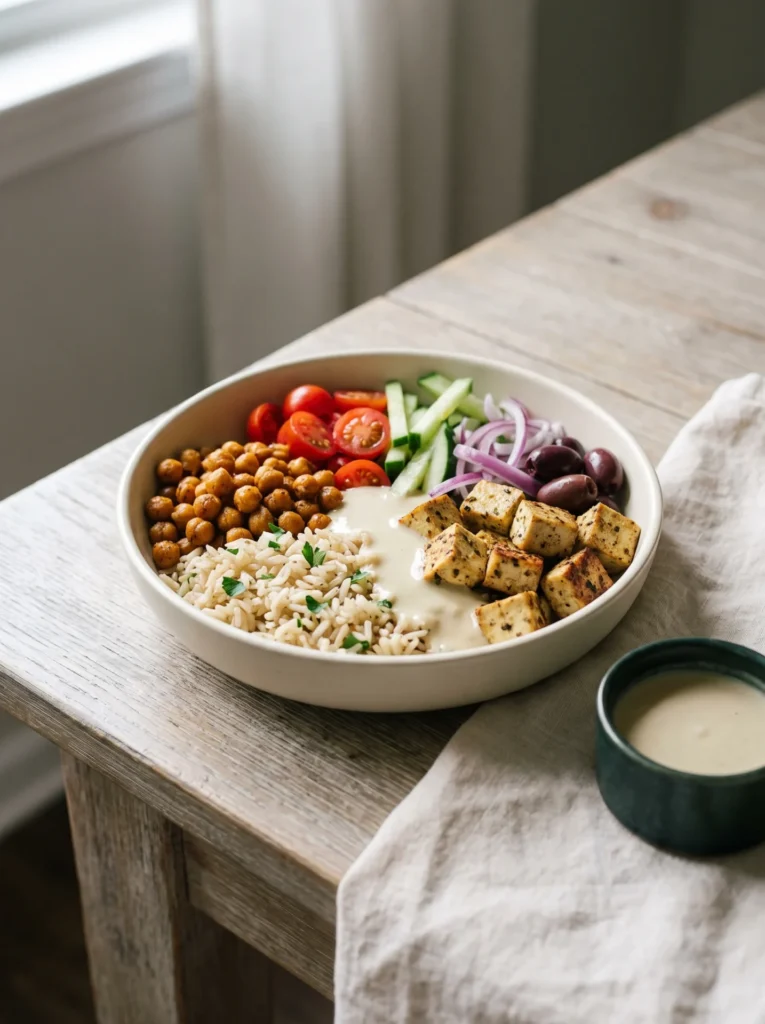
This vegan Mediterranean rice bowl runs on one saucepan and one sheet pan: chickpeas and tofu roast together until the chickpeas split and crackle, while brown basmati steams quietly alongside. A garlicky tahini dressing pulls it together, and the raw vegetables go in last so they stay cold and sharp against the warm grain. It is one of the few vegan recipes that clears 30 grams of protein a serving without protein powder or a mock meat.
Table of Contents
Why this vegan Mediterranean rice bowl works
- Two proteins, not one. A can of chickpeas on its own stalls near 18 grams a serving. Roasting a pressed block of extra-firm tofu on the same pan carries the total to 30 grams, which is what makes this a high protein vegan bowl rather than a rice dish with beans scattered over it.
- Dry beans, hot pan. Chickpeas only crisp once the water clinging to their skins has gone. Rolling them dry in a towel and dropping them onto a sheet pan that is already screaming hot is the whole difference between crackling and leathery.
- One cold layer, one warm layer. The tomatoes, cucumber and red onion never see the oven, so they hold their bite and their acidity cuts straight through the sesame richness of the dressing.
- Twelve grams of fibre, mostly from the beans. Harvard’s Nutrition Source describes legumes as a low-glycaemic source of protein and fibre whose protein and fibre content may increase feelings of fullness.
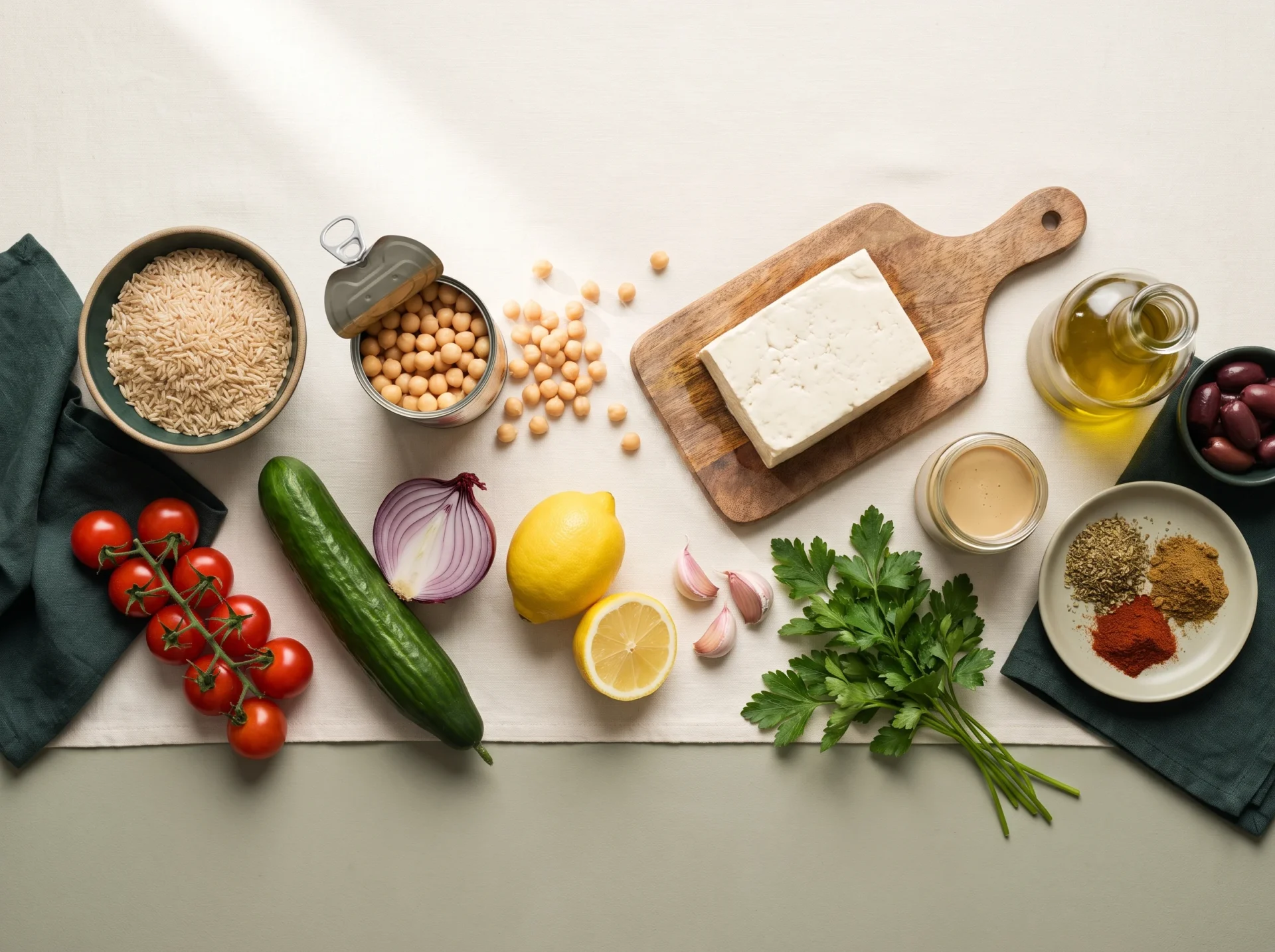
Ingredients
Makes 4 servings.
Equipment
How to make it
- Start the rice. Bring the rinsed rice, water and 1/4 tsp of the salt to a boil in the covered saucepan. Drop to the lowest simmer and cook 25 minutes, until the water is absorbed and small craters open across the surface. Pull it off the heat and leave the lid on for 10 minutes.
- Heat the pan empty. Slide the bare sheet pan into the oven and set it to 425°F (220°C). Preheating the pan itself means the surface moisture flashes off the second the food lands, instead of pooling and steaming.
- Press the tofu. Wrap the block in a clean towel, rest something heavy on top and leave it 10 minutes while the oven comes up. Unwrap and cut into 3/4-inch (2 cm) cubes.
- Dry the chickpeas properly. Roll the drained chickpeas in a dry towel until the skins look dull and no water beads on them. Damp chickpeas steam rather than roast, and this is the single most common reason they never crisp.
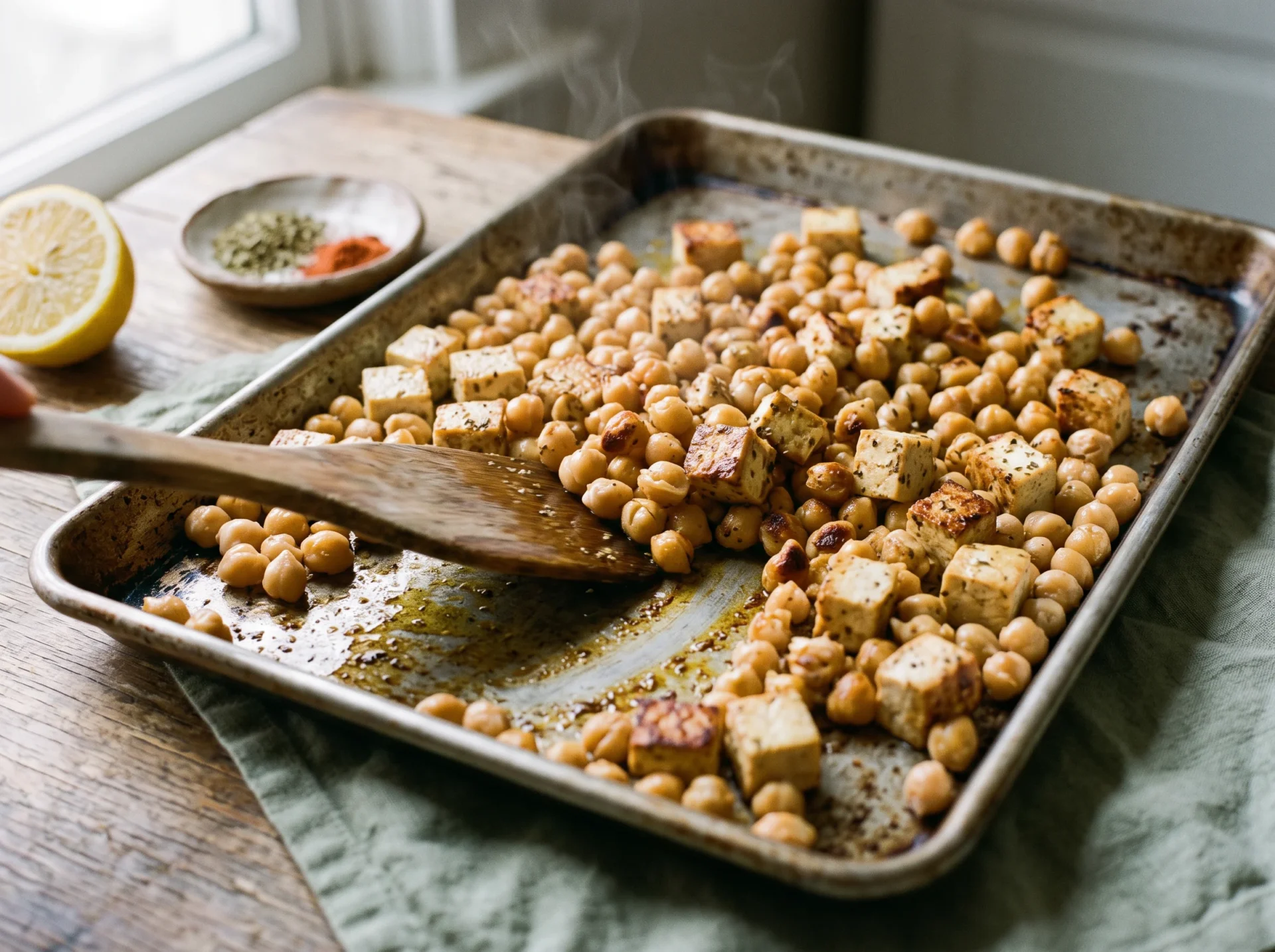
- Season and roast. Toss the tofu and chickpeas with the olive oil, oregano, cumin, paprika and 1/4 tsp salt. Spread them over the hot pan in one uncrowded layer and roast 25 minutes, turning once at the 15-minute mark, until the chickpeas are deep gold and split at the seams and the tofu corners are browned and firm. They go on crisping for a few minutes as they cool, so pull them before they darken past amber.
- Whisk the sauce. Combine the tahini, lemon juice, grated garlic and remaining 1/4 tsp salt. It will seize into a stiff paste — keep whisking and add cold water a tablespoon at a time until it loosens into a pourable cream that ribbons off the whisk.
- Build the bowls. Toss the cucumber, tomatoes, red onion, olives and parsley together. Fluff the rested rice with a fork and divide it between four bowls, then add the roasted chickpeas and tofu, the raw vegetables and a generous spoonful of sauce over the top.
Practical cooking tips
- Crowding the pan is the second reason crispy roasted chickpeas fail. If the tofu and chickpeas touch on all sides, use two pans — trapped steam undoes everything the hot pan just did.
- Salt the chickpeas again the moment they leave the oven, while the surface oil is still hot enough to hold it. Salt added later slides straight off.
- If the lemon tahini sauce stays gluey no matter how much water goes in, the tahini has separated in the jar. Stir the jar down to the bottom before measuring.
- Resist lifting the saucepan lid during the 10-minute rest. That trapped steam is what finishes the grains and keeps the rice from turning gummy at the bottom.
- Salt the sliced red onion for five minutes and rinse it if raw onion is too sharp for you — it keeps the crunch and loses the burn.
Swaps and variations
- Quinoa for the rice. Swapping the 190 g of brown basmati for 180 g of dry quinoa lands close to the same calories but adds roughly 5 g of protein and 2 g of fat a serving, and cuts the cooking time to 15 minutes.
- Tempeh for the tofu. An equal 400 g of tempeh pushes protein to about 37 g a serving and calories to roughly 690, with a firmer, nuttier bite. Steam it 10 minutes first to soften its bitterness.
- Two cans of chickpeas, no tofu. Protein drops to about 22 g a serving and fibre climbs to 16 g. Good if you want it lighter; not the version to make when protein is the point.
- Spice it like a stew. Trade the oregano for a spoonful of harissa in the oil, the way our harissa chickpea stew does, and finish with mint instead of parsley.
Storage and meal prep
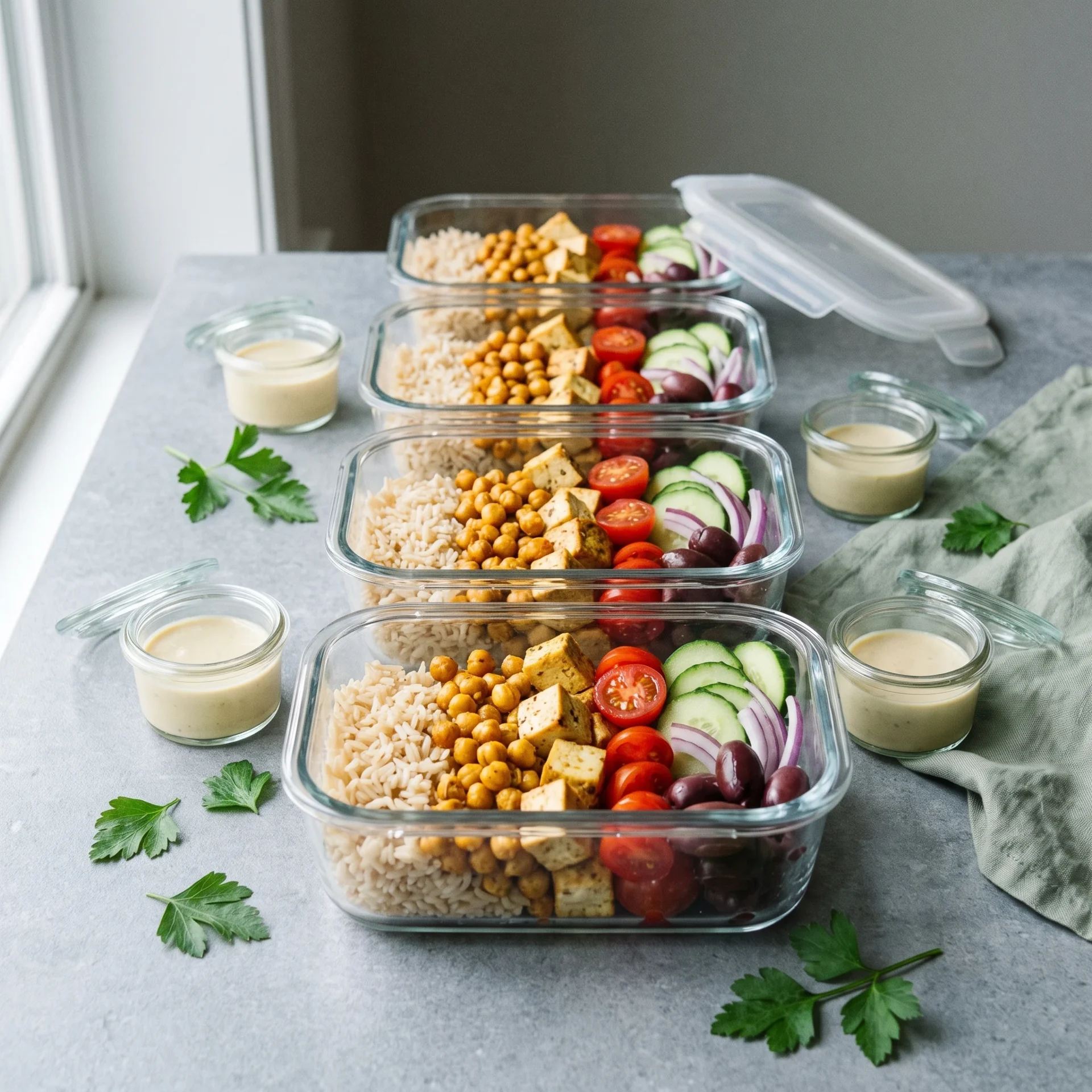
This works as a vegan meal prep bowl on one condition: pack the parts apart. Divide the rice and the roasted chickpeas and tofu into containers while they are still warm — the UK Food Standards Agency advises splitting food into smaller portions so it chills quickly, keeping the fridge between 0 and 5°C (32–41°F), and eating leftovers within 48 hours or freezing them. Rice deserves that care in particular, because it can carry spores that survive cooking and multiply while it sits warm on the counter. Keep the raw vegetables and the sauce in separate pots and add them cold at the last moment. The rice and roasted topping reheat well in a covered dish in the microwave until steaming hot throughout; the cucumber and tomatoes do not survive reheating, and neither does the crunch on the chickpeas, which softens overnight however carefully you store it. Assembled and dressed, this vegan Mediterranean rice bowl is best eaten the same day. The rice and roasted topping also freeze for up to 3 months.
Nutrition per serving
| Nutrient | Per serving |
|---|---|
| Calories | 607 kcal |
| Protein | 30 g |
| Fat | 28 g |
| Total carbs | 65 g |
| Fiber | 12 g |
| Net carbs | 53 g |
Nutrition is an estimate calculated from the quantities written above using USDA FoodData Central entries, and varies with brands and exact portion sizes.
Frequently asked questions
Is this vegan Mediterranean rice bowl gluten free?
Yes, as written. Rice, chickpeas, tofu, tahini and the vegetables are all naturally gluten free. Check the tofu and the tahini labels anyway if you are cooking for coeliac disease, since shared production lines are the usual source of contamination.
How do I get 30 grams of protein without the tofu?
Use tempeh or seitan in the same 400 g weight rather than doubling the chickpeas. Chickpeas carry roughly 7 g of protein per 100 g drained, so replacing 400 g of tofu with beans alone costs you around 8 g a serving and adds a lot of carbohydrate.
Why did my chickpeas come out soft instead of crisp?
Almost always moisture or crowding. Dry them until no water beads on the skins, preheat the empty sheet pan, and leave gaps between the pieces. A cold pan and a wet chickpea produce steam, and steam is the opposite of a crust.
Can I make this plant based Mediterranean bowl with white rice?
You can. Use 1 1/2 cups (355 ml) water to 1 cup of white basmati and simmer 12 minutes instead of 25. Per serving that trades about 2 g of fibre for a slightly softer texture; the protein figure barely moves.
Does this fit the Mediterranean eating pattern?
It sits comfortably inside it — a whole grain, a legume, olive oil, and a plate weighted toward vegetables. The Mediterranean diet is a dietary pattern rather than a medical treatment, and this is one bowl within it. Browse the full recipe archive if you want to build a week around the same idea.
Ratings and reviews
No ratings yet. If you have cooked this, your rating helps the next person decide.
Rate this recipe