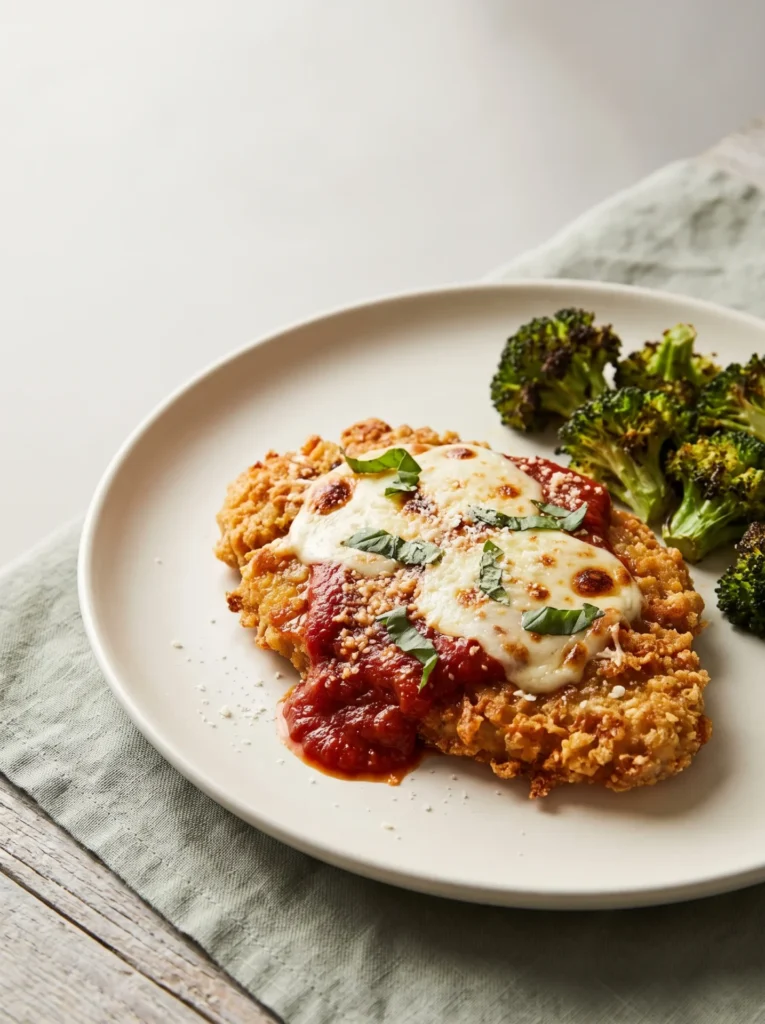
Keto chicken parmesan meal prep fails on exactly one thing: a coating that has turned to paste by Tuesday. The fix is a crust built from crushed pork rinds and hard parmesan rather than almond flour, plus containers that keep the sauce in its own pot until the moment you eat. It is one of the more forgiving keto dinners to batch, and it comes out of the fridge on day four still cracking under a fork.
Table of Contents
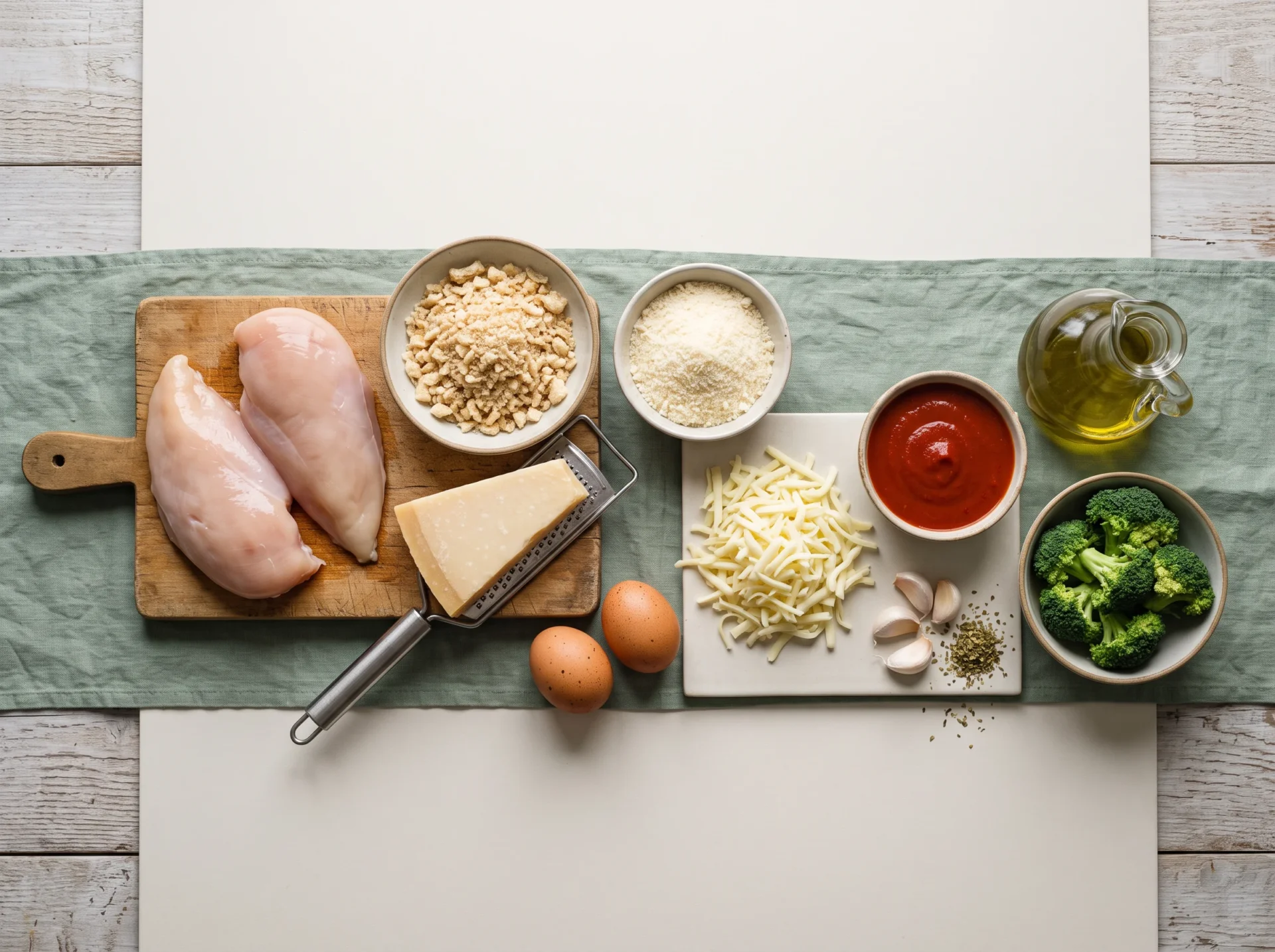
Ingredients
Makes 4 servings.
Equipment
How to make it
- Roast the broccoli first. Heat the oven to 425°F (220°C). Toss the florets with 1 Tbsp of the olive oil and a pinch of salt, spread them on a rimmed sheet pan, and roast 18 to 20 minutes until the tips are browned and a stem gives to a knife with slight resistance. Stop while it is still firm; it softens again on reheating.
- Mix the pork rind breading. Pulse the pork rinds to fine crumbs, then stir in the parmesan, Italian seasoning and garlic powder in a shallow dish. Beat the eggs in a second dish. Break down anything larger than a lentil — big shards do not adhere and fall away in the pan.
- Bread the cutlets. Season the cutlets on both sides, dip each one in egg and let the excess run off for a second or two, then press it firmly into the crumbs. Press, do not sprinkle: the contact is what makes the parmesan bind the coating to the meat.
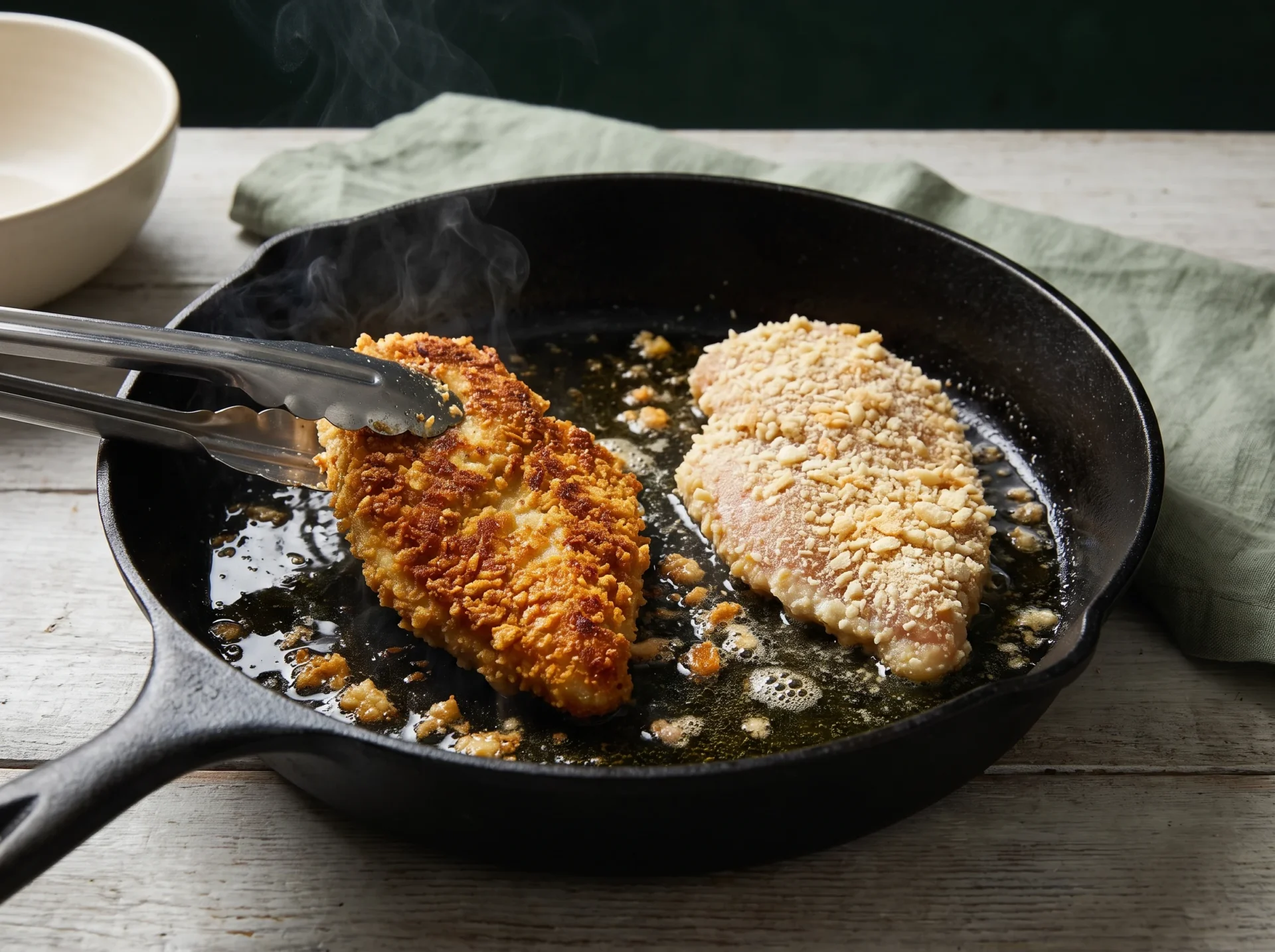
- Sear until the crust sets. Heat 2 Tbsp olive oil in the skillet over medium-high until it shimmers. Cook two cutlets at a time, 3 to 4 minutes per side, until the crust is deep gold and releases from the pan without tugging. Do not crowd the pan and do not flip early — a crowded pan traps steam and the crumbs soften instead of browning.
- Check the internal temperature. Cook until the thickest part of each cutlet reads 165°F (74°C) on an instant-read thermometer, the safe minimum internal temperature for poultry. Thin cutlets usually reach it during the sear; thicker ones can finish in the oven for 3 to 4 minutes.
- Simmer the sauce on its own. Wipe the skillet, warm 1 Tbsp olive oil over medium, and cook the garlic for about 30 seconds until fragrant but not coloured. Add the tomato sauce, oregano and pepper flakes and simmer 5 minutes until it thickly coats a spoon. Keeping it out of the pan with the chicken is the entire point of the method.
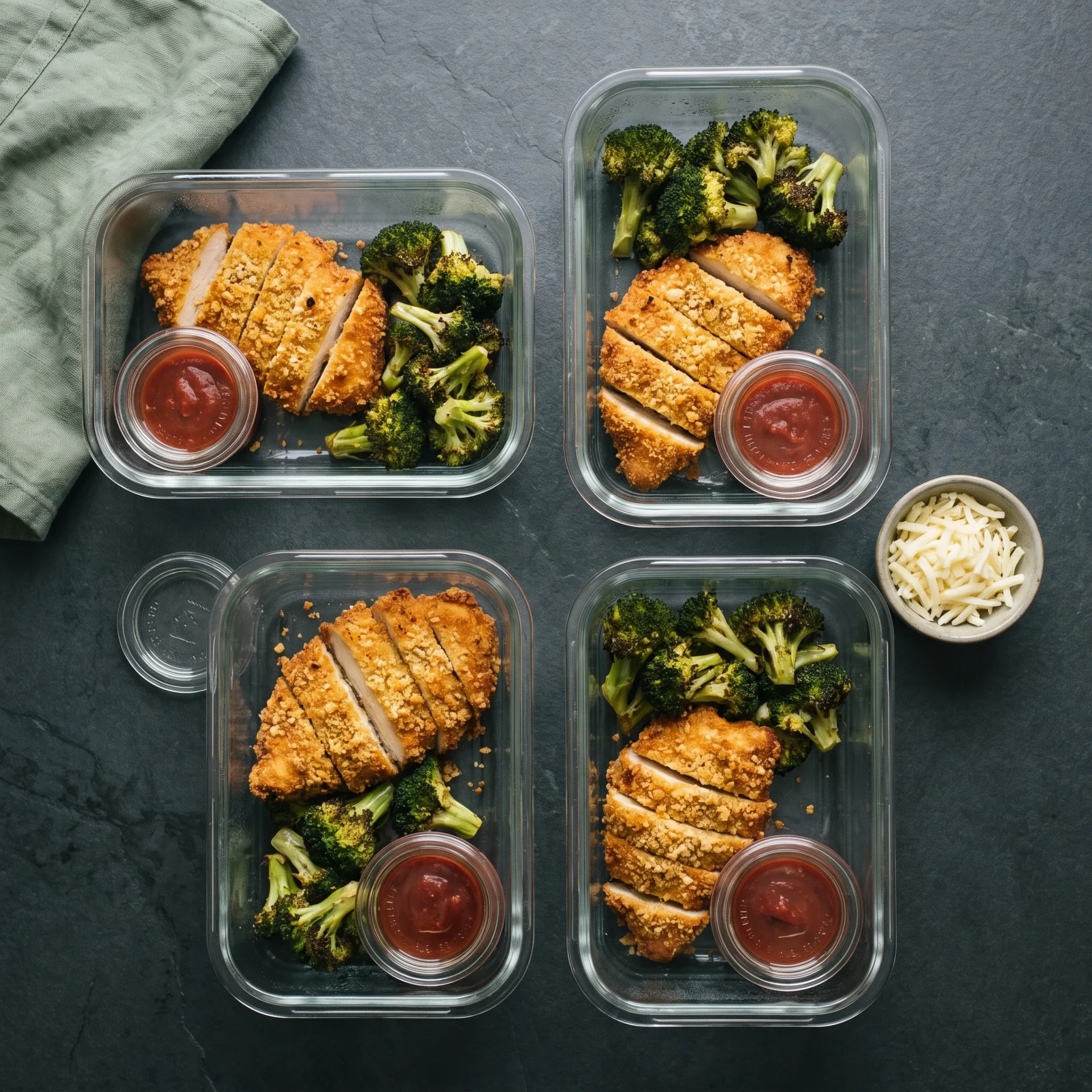
- Cool on a rack, then pack. Rest the cutlets on a wire rack for 10 minutes so steam escapes underneath instead of soaking the crust. Divide the chicken and broccoli between four containers, portion the sauce and the mozzarella into separate pots, and refrigerate within two hours. Eating one now? Spoon over sauce, scatter the mozzarella, and broil 2 minutes until the cheese blisters.
Why this keto chicken parmesan meal prep works
- Pork rinds have nothing to absorb with. They are dehydrated protein and fat with no starch, so they cannot swell and go pasty the way almond flour or crushed crackers do once sauce and condensation reach them.
- Parmesan welds the crumbs down. Hard parmesan melts into the coating as it sears and sets into a shell, which is what stops the crust sliding off in one sheet when you cut a reheated cutlet.
- The sauce travels separately. Packing sauce on top of a crust is the single most common reason a make-ahead cutlet disappoints. Three small pots cost nothing and change the result completely.
- One skillet covers four days. Two chicken breasts, one pan of broccoli in the oven at the same time, and lunch is settled for most of the working week.
Practical cooking tips
- Even thickness beats a longer sear. Slice or pound the cutlets to an even ¾ inch (2 cm). Uneven pieces are the usual reason keto chicken parmesan meal prep ends the week with one dry portion and one underdone one.
- Do not reach for almond flour. It absorbs moisture from the sauce and softens within minutes, which is precisely the failure a low carb chicken parmesan built for the fridge cannot afford.
- Season the crumbs cautiously. Pork rinds and parmesan are both salty already. Taste the mixture before adding anything beyond the seasoning listed.
- The wire rack is not optional. A cutlet cooled on a plate steams its own underside and arrives in the container already soft in the middle.
Swaps and variations
- Air fryer route. For a keto chicken parmesan air fryer version, cook the breaded cutlets at 380°F (193°C) for 10 minutes, turning once, then add sauce and mozzarella for a final 2 to 3 minutes. Same ingredients, so the macros are unchanged.
- Parmesan-only crust. Drop the pork rinds and use ¾ cup (75 g) parmesan alone — keto chicken parmesan no breadcrumbs in its simplest form. It gives a thinner, lacier shell, softens about a day sooner, and takes each serving down by roughly 53 calories and 6 g of protein.
- Leave the mozzarella off. Skipping it entirely removes 90 calories, 6 g of protein and 7 g of fat per serving, and the pork rind crust carries enough savoury weight to stand without it.
- Change the side. Roasted zucchini or the cauliflower rice base from our keto taco skillet both hold their texture overnight. Recalculate the side if you swap it, since the broccoli carries a fair share of the fibre below.
Storage and meal prep
Keto chicken parmesan meal prep keeps 3 to 4 days in the refrigerator at 40°F (4°C) or below, the USDA window for cooked poultry leftovers, and 2 to 6 months in the freezer. Keep the chicken, the sauce and the cheese in three separate compartments — a cutlet left sitting in sauce overnight is a soft cutlet by morning.
How to reheat chicken parmesan without losing the crust: set the cutlet on a wire rack over a sheet pan in a 375°F (190°C) oven for 8 to 10 minutes, or in an air fryer at 350°F (175°C) for 5 to 6 minutes, until it reaches 165°F (74°C). Add the sauce and mozzarella only for the last 2 minutes so the cheese melts while the crust underneath stays dry. The microwave is the one method that cannot work here — it drives moisture out of the meat straight into the crumbs. Reheat the broccoli alongside; it wants the same dry heat.
Nutrition per serving
| Nutrient | Per serving |
|---|---|
| Calories | 633 kcal |
| Protein | 65 g |
| Fat | 36 g |
| Total carbs | 13 g |
| Fiber | 4 g |
| Net carbs | 9 g |
Calculated from USDA FoodData Central entries for each raw ingredient at the weights listed above, counting all 4 Tbsp of olive oil even though some stays behind in the pan. Nutrition is an estimate and varies with brands and exact portion sizes.
Frequently asked questions
How many net carbs are in one serving?
Nine grams — 13 g of total carbohydrate minus 4 g of fiber. Most of that comes from the broccoli and the tomato sauce rather than the crust, so a smaller side brings it lower still.
Will the crust really still be crisp on day four?
It will, provided the sauce never touches it and you reheat with dry heat. Pork rinds hold no starch to go stale and very little moisture to reabsorb, which is why they outlast almond flour and crushed crackers in a container.
Can I freeze the cutlets before cooking them?
Yes. Freeze them breaded and raw in a single layer on a tray, bag them once solid, and sear straight from frozen over medium heat for 6 to 7 minutes per side, checking for 165°F (74°C) at the centre before packing.
Do I have to pound the chicken?
Only if the cutlets are uneven after halving. Slicing a breast lengthwise usually gives two pieces close enough in thickness; pound the thick end lightly if one side is more than about ¼ inch (6 mm) deeper than the other.
What goes with it instead of pasta?
Roasted broccoli is the default here because it survives storage. Zucchini ribbons, cauliflower rice and a plain green salad packed dry all work too — the rule is anything that will not release water into the container overnight. There are more low-carb sides across the recipe archive.
Ratings and reviews
No ratings yet. If you have cooked this, your rating helps the next person decide.
Rate this recipe