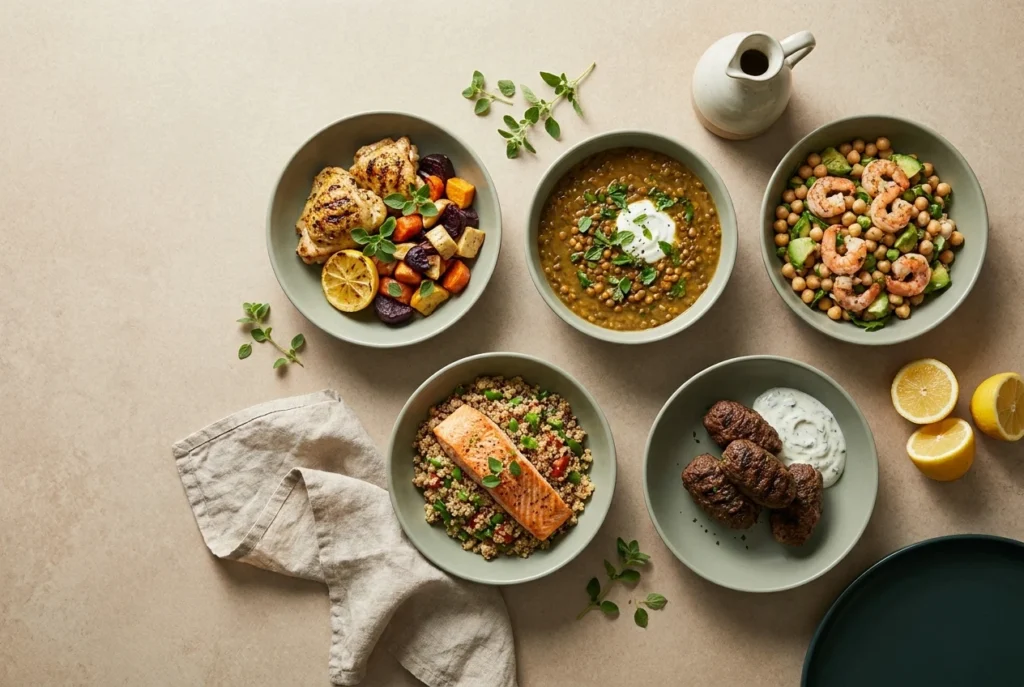
What to eat in 7 days to lose weight comes down to one structure repeated seven times: a protein-led lunch, a vegetable-heavy dinner, and no day that drifts past your calorie target. Below is that exact week, built from fourteen recipes already published on this site — and every calorie and protein number on this page is read from those recipes’ own USDA-based nutrition audits, not estimated for the article.
Key takeaways
- Across the seven days below, lunch and dinner together supply between 747 and 1,143 calories per day, leaving room for a breakfast and a snack inside most adults’ deficit targets.
- Every day in this plan delivers at least 42 g of protein from two meals alone, and five of the seven clear 62 g — protein is the variable that protects lean mass while you are eating less.
- A realistic rate of loss is about 1 to 2 pounds per week, so seven days is enough to establish a pattern and see the scale move — not enough to judge whether the pattern is working.
- Much of what the scale shows in week one is glycogen and the water bound to it, which returns the moment carbohydrates do. Judge the week by whether you could repeat it, not by the number.
- Four of the seven dinners take 30 minutes or less, which is the single strongest predictor of whether a seven-day plan survives past Wednesday.
On this page
What to eat in 7 days to lose weight — the short answer
Eat two anchored meals a day that you do not have to think about, and let breakfast stay small and repetitive. That is the whole mechanism. Weight loss over a week is decided by total energy intake, and the fastest way to control total energy intake is to remove the decisions — which is why this reads as a fixed schedule rather than a list of options.
The two levers that matter inside that structure are protein and volume. In a meta-analysis of randomised controlled trials, higher protein intakes lowered hunger and raised fullness, alongside measurable shifts in the gut hormones that regulate appetite (Zhu et al., 2020). Protein also matters for what you lose rather than how much: in a trial of pre-obese and obese women, a higher-protein intake during energy restriction preserved more lean mass and improved satiety than a lower-protein one (Layman et al., 2007). Volume is the other half — the Harvard Healthy Eating Plate puts vegetables and fruit on half the plate, and every dinner below is built to that ratio.
So a working calorie deficit meal plan is not an exotic food list. It is protein at both meals, vegetables filling the plate, and the same six or seven dishes on rotation until the week is over.
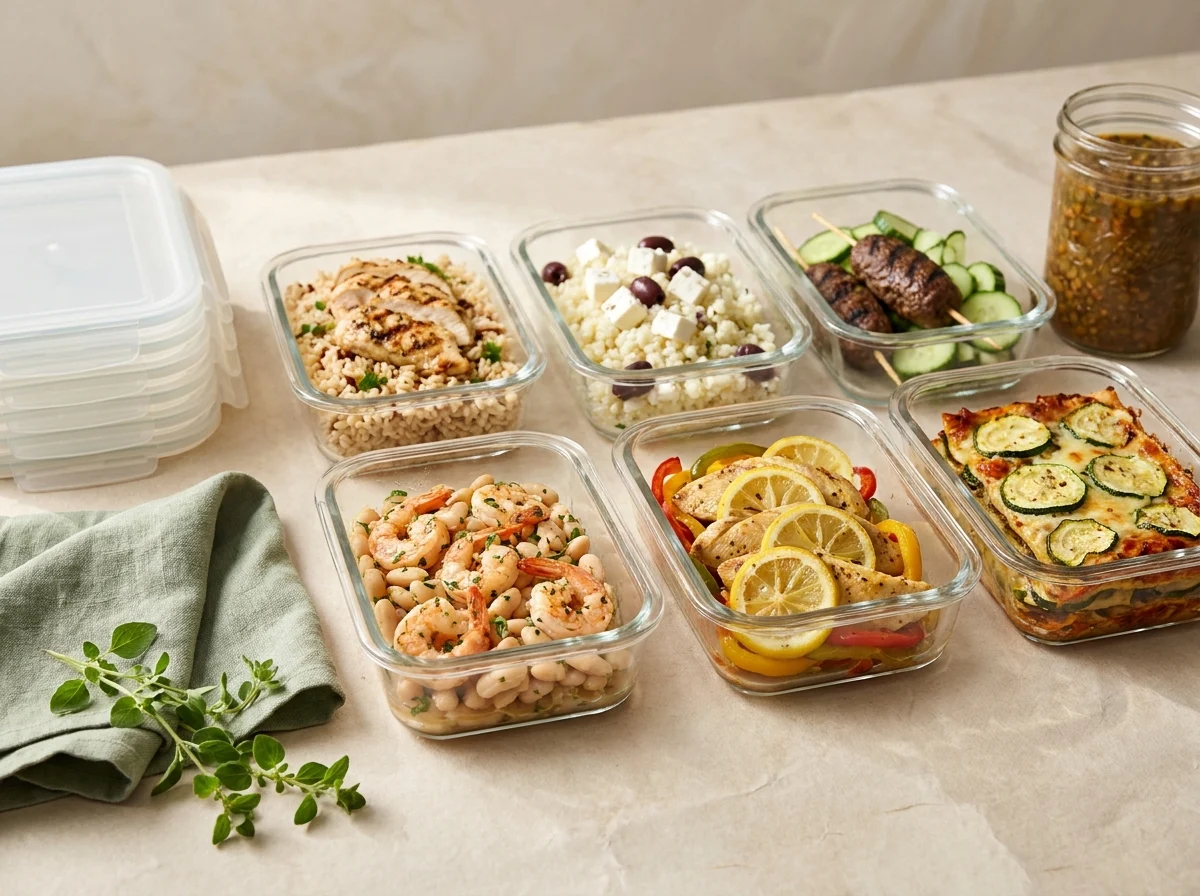
The 7-day plan, day by day
Each day names a lunch and a dinner. Breakfast is deliberately left to you — a fixed pattern you already like, kept to roughly the same size every morning, does more for adherence than a prescribed one you will abandon. The calorie and protein figures beside each dish are per serving, taken from that recipe’s published nutrition audit.
Day 1 — Monday: start with the easiest possible cook
Lunch is Mediterranean Lentil Soup with Lemon and Cumin at 325 calories and 15 g of protein, made in one pot on Sunday night so Monday asks nothing of you. Dinner is Sheet Pan Greek Chicken with Lemon and Oregano, 610 calories and 47 g of protein on a single tray. Day total from two meals: 935 calories, 62 g protein. Roast a double batch of the chicken — Tuesday and Thursday both get easier.
Day 2 — Tuesday: no-cook lunch, comfort dinner
Lunch is No Cook Mediterranean Shrimp Salad with Chickpeas, 370 calories and 35 g of protein assembled in fifteen minutes with no heat at all. Dinner is Keto Lasagna With Roasted Zucchini Noodles at 569 calories and 39 g of protein — a Tuesday that tastes like a cheat day and is not one. Day total: 939 calories, 74 g protein.
Day 3 — Wednesday: the highest-calorie day, on purpose
Lunch is Mediterranean Brown Rice Bowl with Lemon Chicken, 413 calories and 38 g of protein. Dinner is the richest plate of the week at 730 calories and 50 g of protein:
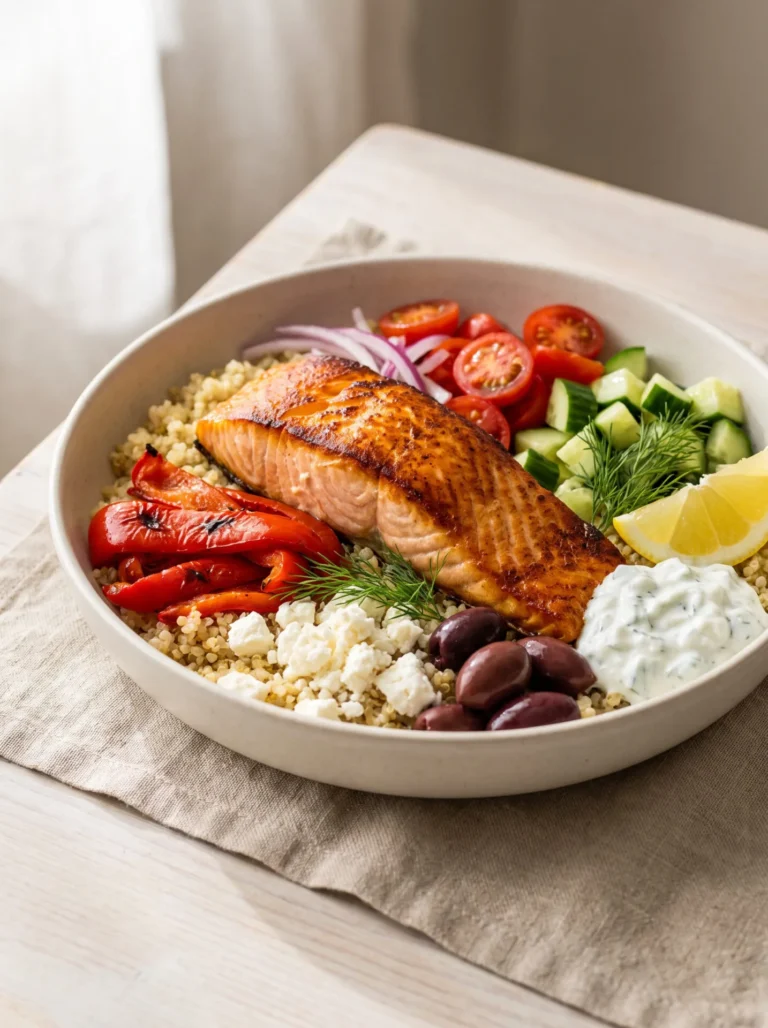
Day total: 1,143 calories and 88 g of protein — the week’s peak. Putting the largest meal midweek is not a lapse in the plan, it is the reason the plan reaches Sunday. A week with no day worth looking forward to gets abandoned on day four.
Day 4 — Thursday: the lightest day
Lunch is Air Fryer Beef Kofta Kebabs with Yogurt Sauce at 297 calories and 27 g of protein. Dinner is Mediterranean Shrimp and White Bean Stew with Lemon, 450 calories and 44 g of protein, where the beans carry the fibre that keeps a light day from feeling like one. Day total: 747 calories, 71 g protein — the lowest of the week, which is why it lands the day after the highest.
Day 5 — Friday: two dishes that feel like eating out
Lunch is Shrimp Saganaki with Tomato, Garlic & Feta, 271 calories and 30 g of protein. Dinner is Greek Ground Beef Gyro Bowl with Tzatziki at 489 calories and 33 g of protein — the Friday takeaway substitute, and the reason Friday is usually where these plans die. Day total: 760 calories, 63 g protein.
Day 6 — Saturday: twenty minutes, twice
Lunch is Air Fryer Mediterranean Shrimp with Feta and Lemon, 292 calories and 37 g of protein in twenty minutes. Dinner is Keto Mediterranean Cauliflower Rice Bowl with Chicken at 624 calories and 45 g of protein. Day total: 916 calories, 82 g protein. These are the two high protein meals for weight loss that do the most work per minute of cooking in the whole week.
Day 7 — Sunday: cook once, set up next week
Lunch is Keto Mediterranean Ground Beef Skillet with Feta, 334 calories and 27 g of protein in one pan. Dinner is the batch cook that turns this from a one-week experiment into a habit:
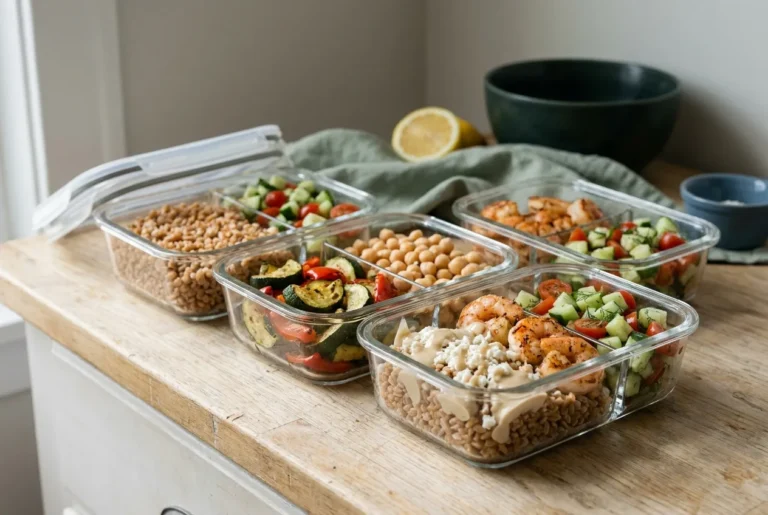
At 634 calories and 46 g of protein across four portions, it is the weight loss meal prep anchor: Sunday’s dinner and two of next week’s lunches come out of the same forty-five minutes. Day total: 968 calories, 73 g protein.
What the week actually adds up to
This is the part no other seven-day plan can show you, because the numbers below are not written for the article — they are the per-serving figures stored with each recipe, each derived from USDA FoodData Central entries for the ingredients as written.
| Day | Lunch + dinner (kcal) | Protein (g) |
|---|---|---|
| 1 — Monday | 935 | 62 |
| 2 — Tuesday | 939 | 74 |
| 3 — Wednesday | 1,143 | 88 |
| 4 — Thursday | 747 | 71 |
| 5 — Friday | 760 | 63 |
| 6 — Saturday | 916 | 82 |
| 7 — Sunday | 968 | 73 |
| Week average | 915 | 73 |
Two things stand out. The spread is deliberate — a 396-calorie gap between the lightest and heaviest day means the plan bends around a Friday dinner or a Wednesday appetite instead of breaking. And the protein floor holds: even Monday, the lowest-protein day at 62 g from two meals, is above what most people manage across an entire unplanned day.
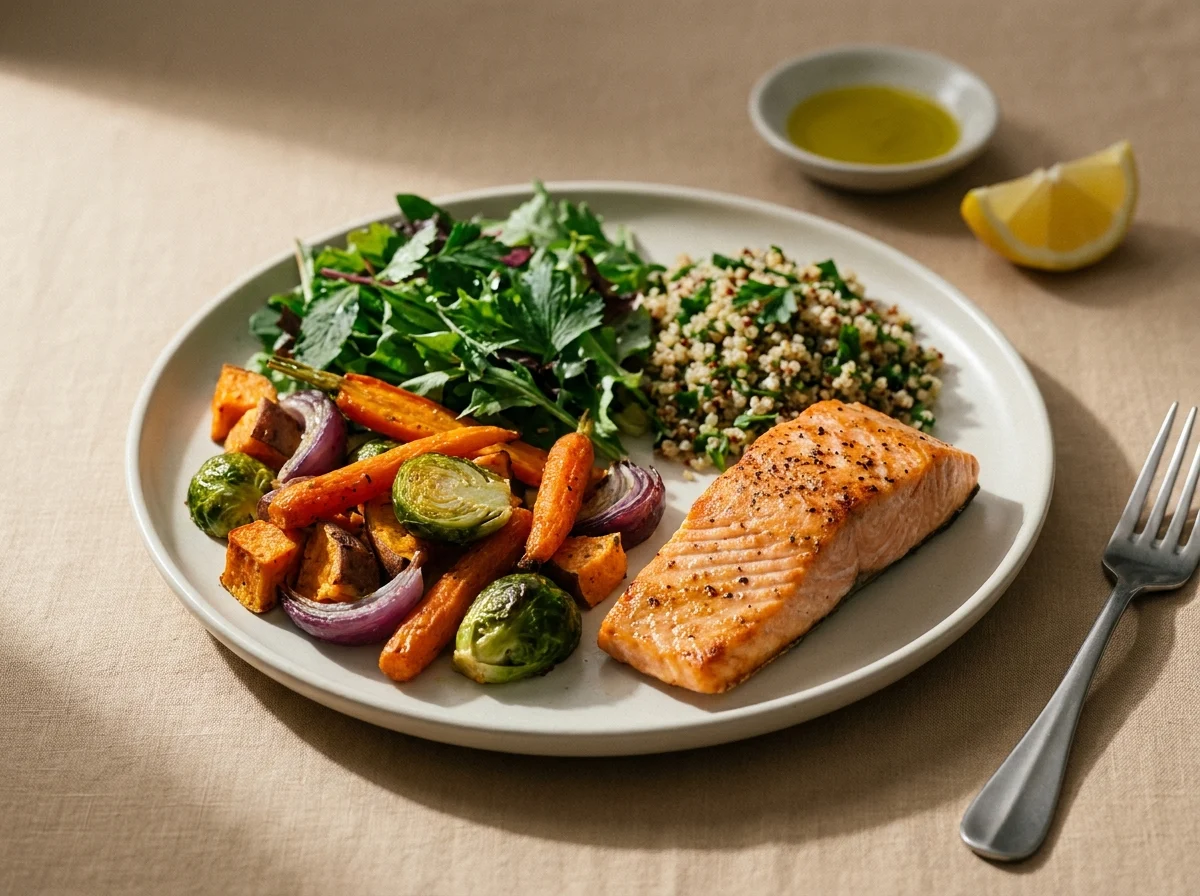
How to scale this to your own calorie target
The plan above is a floor, not a prescription. Two meals averaging 915 calories leaves a gap you fill according to your own target, and here is the arithmetic for doing it honestly.
- Target 1,400 kcal/day. Add roughly 485 calories of breakfast and snacks — a Greek yogurt with fruit and nuts, plus a piece of fruit in the afternoon. On Wednesday, the 1,143-calorie day, that gap narrows to about 257, so keep Wednesday’s breakfast small.
- Target 1,600 kcal/day. Add roughly 685 calories. This is where a real breakfast fits without any day going over.
- Target 1,800 kcal/day. Add roughly 885 calories, or take a second serving of the lighter dinners — Thursday and Friday both have room for it.
- Protein goal. Two meals give you 73 g on average. Adding 25–30 g at breakfast puts most people near 100 g a day without a shake or a supplement.
Note what this does not do: it does not tell you your calorie target. That depends on your body size, your activity and your goal, and any 7 day meal plan for weight loss that hands you a single number for everybody is guessing. Work out your own target first, then use the gaps above.
What to skip in the first seven days
The honest section, and the one missing from every other plan on this query.
Skip the conclusion. A large share of what the scale gives up in week one is glycogen and the water stored with it, which is why the drop is fast at first and why the scale climbs again as soon as carbohydrates return — an effect described in the literature as an illusion of easy weight loss that also distorts body-composition estimates (Kreitzman et al., 1992). A gradual rate of about 1 to 2 pounds a week is the benchmark the CDC associates with keeping weight off. Seven days tells you whether you can live like this. It does not tell you your rate.
Skip the detox week. Juice-only and single-food weeks strip out the protein that the trials above associate with preserved lean mass — the opposite of what a short, aggressive week should be protecting.
Skip cutting the light days lighter. Thursday is already the week’s floor at 747 calories from two meals. Cutting further is where hunger stops being manageable and the plan ends on Saturday.
Skip fourteen different dishes. The plan above reuses a double batch of Monday’s chicken and turns Sunday’s dinner into next week’s lunches. Repetition is not a failure of imagination in healthy meals to lose weight — it is the mechanism. Browse the full recipe archive when the week is over, not during it.
Frequently asked questions
How much weight can I actually lose in 7 days?
Roughly 1 to 2 pounds of genuine loss, per the CDC’s benchmark for a rate people sustain. The scale may show more in week one because glycogen and its bound water leave first, and that portion returns when carbohydrates do.
Do I have to eat breakfast on this plan?
No — the plan fixes lunch and dinner and leaves breakfast to you on purpose. If you skip it, the two meals average 915 calories a day, which is below most adults’ targets, so check the scaling section before running the week that way.
Can I follow this if I eat keto?
Partly. Four of the fourteen dishes are already keto, and Thursday’s stew, Monday’s soup and Wednesday’s rice bowl are the carbohydrate-heavy ones to swap. The keto recipe collection has direct replacements at similar calorie counts.
What should I eat in 7 days to lose weight if I do not cook?
Run Day 2 and Day 6 repeatedly. The no-cook shrimp salad needs no heat, the air fryer shrimp needs twenty minutes, and both clear 30 g of protein — a two-dish rotation beats an ambitious plan you stop on Tuesday.
How much protein should I aim for in a week like this?
Higher intakes are associated with better satiety and more preserved lean mass during energy restriction, but the trials do not converge on one number for everyone. This plan supplies 73 g a day from two meals; adding a protein-led breakfast brings most people near 100 g.
What happens after the seven days?
Repeat the days that were easy and replace the ones that were not. A week is a test of whether the structure fits your schedule, and the two or three dishes you would happily eat again are the real output — not the number on the scale.
Note: This article is for general information and is not medical advice. Nutrition figures are estimates that vary with brands, ripeness, and portion size. Talk to a doctor or registered dietitian before changing your diet, especially if you are pregnant, managing diabetes or kidney disease, or taking prescribed medication.